This blue song kicks off with a smooth, slow groove, drawing you in with its mellow rhythm. Gradually, it erupts into a vibrant, full-blown blues and jazzy jam, overflowing with upbeat energy and positive vibes. By the time the last note fades, you're left with a feeling of complete satisfaction.
2025
Rock
15 tracks
49:41
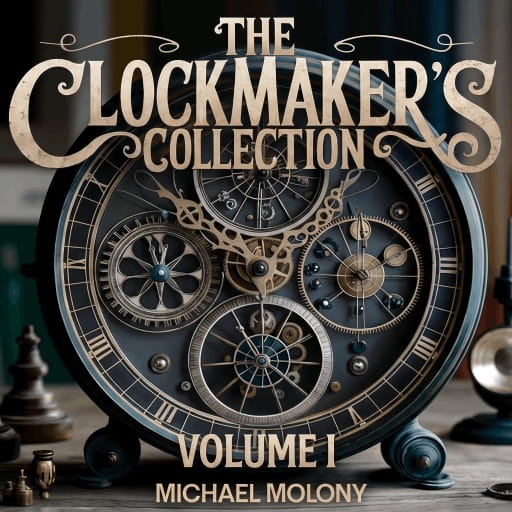
Clockmaker's Collection (Volume I)
This album is a multi-genre showcase of Michael Molony's diverse musical talent. Featuring a curated selection of songs spanning progressive rock, country, classical, theatre, and blues/jazz, it offers a glimpse into decades of his musical experimentation and lyrical craftsmanship.
Track Listing
There's something achingly familiar about the restless spirit that animates "Sun City Blues," the kind of song that feels like it's been waiting decades to be written. Michael Molony has crafted a piece that sits comfortably in rock's grand tradition of highway songs and existential wandering, yet brings its own weathered wisdom to the journey.
The title itself conjures images of desert heat and artificial paradise—perhaps that retirement community mirage in Arizona, or maybe just any place where dreams go to bask in perpetual sunshine until they fade. Molony understands that the blues isn't always about heartbreak; sometimes it's about the peculiar melancholy of arriving exactly where you thought you wanted to be, only to find yourself still searching.
As part of The Clockmaker's Collection - Volume I, "Sun City Blues" feels like one of those perfectly preserved moments—a snapshot of American restlessness that could have emerged from any era of rock music, from the late Sixties onward. There's an timeless quality to Molony's approach here, suggesting an artist who understands that the best songs don't chase trends but instead tap into something deeper and more enduring.
The track serves as compelling evidence that 2025 might be the year thoughtful rock songwriting reclaims some cultural territory. Molony has delivered something that feels both nostalgic and immediate—a song that honors its lineage while carving out its own distinct emotional landscape.
Michael Molony's "Chilly Back Road Blues" captures that universal moment when the road stretches endlessly ahead and shelter feels like a distant dream. Opening The Clockmaker's Collection - Volume I with raw authenticity, this track transforms a simple narrative of walking through rain-soaked countryside into something deeply resonant about perseverance and human longing.
Molony paints his scene with masterful economy—mud-heavy boots, bending trees, and hollow barns create a landscape that feels both specific and archetypal. The imagery works on multiple levels: those "chilly winds whisper, cutting like a blade" aren't just about weather, but about the sharp edges of uncertainty we all navigate. His protagonist moves through a world where "every puddle reflects the storm I hide," turning external elements into mirrors of internal struggle.
The song's strength lies in its restraint. Rather than overwrought metaphors, Molony lets simple, honest language carry the emotional weight. The repeated chorus—"Oh, I'm looking for a place to take a break"—becomes both literal plea and spiritual yearning, that fundamental human need for respite and warmth in an indifferent world.
Within the rock framework, "Chilly Back Road Blues" channels the storytelling tradition of American roots music while maintaining contemporary relevance. It's the kind of song that makes you want to pull closer to whatever fire you can find, grateful for warmth and wondering about all the wanderers still out there on their own back roads, searching for shelter.
♪ Show Lyrics
"Chilly Back Road Blues"
Music & Lyrics by Michael Molony © 2025
Walking alone, rain on my skin
A back road so quiet, where’s it begin?
Chilly winds whisper, cutting like a blade
Looking for shelter, where my fears might fade
Mud on my boots, heavy and slow
Every step deeper, with nowhere to go
Oh, I’m looking for a place to take a break
A little warmth, or a fire I can make
This road keeps winding, my spirit aches
Oh, I’m looking for a place to take a break
Trees bend low, shadows stretch wide
Every puddle reflects the storm I hide
Hollow barns lean, roofs torn away
No welcome sign, no reason to stay
Breath like fog, rising in the night
Hoping for a spark, or a porch light
Oh, I’m looking for a place to take a break
A little warmth, or a fire I can make
This road keeps winding, my spirit aches
Oh, I’m looking for a place to take a break
Michael Molony's "Stars Collapse" transforms cosmic devastation into a meditation on resilience, crafting something unexpectedly hopeful from the bleakest of imagery. The opening lines paint a universe in decay — stars dying, light extinguishing, gravity dragging everything toward oblivion — yet Molony finds profound beauty in this celestial entropy, using it as a canvas for one of the most compelling examinations of personal transformation in recent rock music.
What elevates this track beyond mere space-rock theatrics is Molony's ability to make the vastness feel intimate. His verses drift through "nebula's haze" and "ghostly maze" with the same emotional weight as someone navigating loss or depression, turning astronomical phenomena into metaphors that resonate on a deeply human level. The recurring refrain becomes a mantra of endurance: "In the darkest night a spark will glow / From the depths of doom new strength will grow."
As the opening statement for The Clockmaker's Collection - Volume I, "Stars Collapse" establishes Molony as an artist unafraid of grand themes. His rock arrangements provide the perfect vehicle for these cosmic visions, grounding the ethereal lyrics with earthbound power. The song's arc mirrors its central message — beginning in darkness but building toward that triumphant final verse where the narrator emerges "renewed and brighter than the twinkling night." It's a stunning piece of songcraft that finds light in the void and makes that discovery feel both universal and deeply personal.
♪ Show Lyrics
"Stars Collapse"
Music & Lyrics by Michael Molony © 2025
Stars collapse and the light fades slow
Drifting through space in an endless flow
Gravity pulls to the depths unknown
Echoes of silence chill to the bone
Falling into the black no path to show
Lost in the void where shadows grow
In the darkest night a spark will glow
From the depths of doom new strength will grow
Memories float in a nebula’s haze
Time stands still in this ghostly maze
In the heart of dark where fears rebel
Wisdom awakens in the shadow’s dwell
Falling into the black no path to show
Lost in the void where shadows grow
In the darkest night a spark will glow
From the depths of doom new strength will grow
Through the cosmic dust and endless flight
Transform the soul in the absence of light
Rise from the ashes of the black first light
Renewed and brighter than the twinkling night
Emerging from the black a new path to show
Found in the void where courage will grow
In the darkest night a spark will glow
From the depths of doom new strength will grow
There's something haunting about swans that has captivated artists for centuries — their grace masking an underlying wildness, their beauty shadowed by mortality — and Michael Molony taps into this timeless fascination with "The Last Swan," a standout piece from his ambitious new collection. The track arrives as part of The Clockmaker's Collection - Volume I, where Molony has crafted what feels like a series of musical timepieces, each song measuring different moments of human experience with meticulous care.
"The Last Swan" embodies the album's broader meditation on endings and preservation, but it does so with a particularly cinematic sweep that places it among the collection's most emotionally resonant moments. Molony's approach here feels both intimate and expansive, as if he's discovered something profound in the image of that final, solitary bird. The song carries the weight of finality without succumbing to despair, finding instead a kind of dignified melancholy that speaks to anyone who has witnessed the end of something beautiful.
Within the rock framework that defines much of Molony's work, "The Last Swan" demonstrates his growing confidence as both a songwriter and a storyteller. The track serves as a compelling argument for treating each song as a small, perfect mechanism — much like the clockmaker's art that inspired this collection. It's music that understands how precious moments become when we know they won't last forever.
Michael Molony's "Love's Just a Crooked Line" captures the restless ache of romantic disillusionment with the kind of lived-in poetry that makes great rock songwriting feel inevitable. Opening with the haunting image of "fading radio dreams" and "static whispers," Molony establishes a world where communication breaks down at the most crucial moments—a perfect metaphor for love's frequent failures to bridge the distances between hearts.
The song's central metaphor is both simple and profound: love as a crooked line, never straight, never predictable, always veering off course just when you think you've found your direction. Molony weaves this idea through verses that feel like snapshots from a relationship's wreckage—cut wires, scattered words, buried vows. There's something cinematic in his imagery, painting ghost towns and hollow streets that serve as external landscapes for internal desolation.
What makes this track compelling is how Molony balances vulnerability with resignation. The repeated plea to "set me free" carries both desperation and acceptance, while images like echoes "slipping through my hands like wine" suggest someone who's learned to find beauty even in loss. The song inhabits that sweet spot where classic rock storytelling meets contemporary emotional honesty, recalling everyone from Tom Petty to The National in its ability to find universal truth in personal disappointment.
As the opening salvo from The Clockmaker's Collection - Volume I, this track establishes Molony as a songwriter unafraid to explore love's messier territories with both tenderness and clear-eyed wisdom.
♪ Show Lyrics
"Loves Just A Crooked Line"
Music & Lyrics by Michael Molony © 2025
Fading radio dreams
Static whispers, won’t you send me a sign?
Told myself, "Hold on tight,"
But the wires cut loose
Left me driftin’ through time
Oh, set me free—
The echoes tauntin’ me
They slip through my hands like wine
I should’ve known the tide
But everybody knows love’s just a crooked line
Yeah, love’s just a crooked line
Yeah, love’s just a crooked line
Pull you close, let you slip
When the night gets heavy, I vanish inside
You swore we had a chance
But the wind took the words
Left ‘em scattered behind
Oh, set me free—
The echoes tauntin’ me
They slip through my hands like wine
I should’ve known the tide
But everybody knows love’s just a crooked line
Yeah, love’s just a crooked line
Yeah, love’s just a crooked line
Ghost towns, hollow streets
Static whispers, won’t you wake me this time?
Buried vows in the deep
Heaven, please—
I’m losin’ the fight
Oh, set me free—
The echoes tauntin’ me
They slip through
My hands like wine
I should’ve known the tide
But everybody knows love’s just a crooked line
Michael Molony conjures pure Saturday night magnetism with "Linda Lou's Blues," a scorching slice of roadhouse rock that captures the dangerous allure of a small-town femme fatale. This standout track from The Clockmaker's Collection - Volume I pulses with the kind of smoky, sultry energy that made classic rock and blues immortal, painting Linda Lou as the kind of woman who walks into a club and rewrites the rules simply by existing.
Molony's storytelling prowess shines as he sketches this captivating character study in vivid, cinematic strokes. Linda Lou emerges as both muse and menace, swaying through the verses in that infamous red satin dress while leaving a trail of mesmerized men and jealous wives in her wake. The imagery crackles with authenticity—cigarettes and whiskey hanging in the air, the hypnotic spell of the dance floor, the electric tension between desire and danger that defines the best blues narratives.
What elevates "Linda Lou's Blues" beyond mere character sketch is Molony's understanding of the archetypal power at play. Linda Lou isn't just a local legend; she's every mysterious woman who ever commanded a room, every heartbreaker who danced on the edge of scandal. The infectious chorus hook—"What you gonna do?"—becomes both taunt and invitation, capturing the helpless fascination she inspires. This is rock storytelling at its most vivid and engaging, a track that transforms the listener into another patron at that smoky club, watching the magic unfold.
♪ Show Lyrics
"Linda Lou's Blues"
Music & Lyrics by Michael Molony © 2025
Down by the club
Every night so true
Linda Lou's dancin'
Got us all in a stew
Teasin' and twirlin' in that red satin dress
Men can't resist
Can't help but confess
She's got that sway
Those moves so fine
Stealin' hearts
Takin' names each time
Wives lookin' on
With a fiery glare
Can't tame the flame
Dancin' without a care
Oh Linda Lou
What you gonna do?
Got the whole town fallin'
Fallin' for you
Dancin' and teasin'
You make 'em all woo
Oh Linda Lou
What you gonna do?
Every man dreams
Every woman pouts
Linda Lou's magic
Can't figure it out
She's the queen of the night
With a tantalizing reign
Makes 'em lose their minds
Drives 'em all insane
Cigarettes and whiskey
Playin' in the air
Linda Lou winks
With her devilish flair
The band plays on
She lights up the floor
Men are hypnotized
Always beggin' for more
Oh Linda Lou
What you gonna do?
Got the whole town fallin'
Fallin' for you
Dancin' and teasin'
You make 'em all woo
Oh Linda Lou
What you gonna do?
There's something achingly beautiful about watching legends take their final bow, and Michael Molony captures that bittersweet moment with stunning clarity on "Last Ride." This stirring anthem from The Clockmaker's Collection - Volume I reads like a love letter to the enduring power of music and the bonds that survive even when the curtain falls.
Molony paints an evocative portrait of weathered musicians gathering for one final performance, their "old hands" finding familiar comfort on worn strings while "smokes and lights" recreate the atmosphere of countless nights before. The imagery is cinematic—dusty boots on aged wood, dim hall lights catching knowing glances, whiskey burning as bright as the passion that "never will age." These aren't just musicians; they're storytellers carrying decades of shared experience into one last magical evening.
The song's emotional weight comes from its unflinching honesty about endings. Where lesser songs might wallow in sentimentality, Molony balances melancholy with defiance. Yes, this is goodbye, but these artists "stand tall" as they deliver every note with the accumulated wisdom of a lifetime in music. The repeated refrain "ridin' the wind strummin' through the night" transforms their final performance into something transcendent—not just an ending, but a celebration of everything that brought them to this moment.
"Last Ride" stands as both tribute and meditation, honoring the resilience of artists who've given everything to their craft while acknowledging that even the most beautiful journeys must eventually reach their destination.
♪ Show Lyrics
"Last Ride"
Music & Lyrics by Michael Molony © 2025
Old hands strum the strings again feel the music rise
Smokes and lights just like the past fire (in our) in our eyes
Crowds cheering loud faces they once knew
Last ride together hearts beatin' blue
Singin' for the last time under the twilight sky
Every note every chord says goodbye
Ridin' the wind strummin' through the night
This is the end this is our last ride
Wrinkled smiles as we hit the first note
Memories floodin' like a worn-out road
Guitars echo dreams of our youth's craze
Last ride together in a fiery blaze
Singin' for the last time under the twilight sky
Every note every chord says goodbye
Ridin' the wind strummin' through the night
This is the end this is our last ride
Dusty boots stompin' on aged wood stage
Whiskey's burn the passion never will age
Eyes meet in the dim lights of the hall
Last ride together but we'll stand tall
Singin' for the last time under the twilight sky
Every note every chord says goodbye
Ridin' the wind strummin' through the night
This is the end this is our last ride
Whispers of the Nile
There's something utterly transporting about "Whispers of the Nile," the kind of song that immediately pulls you into its dusty, moonlit world and refuses to let go. Michael Molony has crafted a piece that feels both ancient and immediate, where rock sensibilities meet the timeless mystique of Egypt's great river. From the opening lines about sand humming hymns under quiet moonlight, you're drawn into a landscape where history breathes through every verse.
The song's genius lies in its ability to make the mythic feel personal. Molony doesn't just paint pretty pictures of broken statues and dancing shadows — he creates a dialogue between past and present, where "stone hands frozen" and wind that "sings the past away" become metaphors for memory itself. The recurring chorus of whispers carried "miles and miles" becomes hypnotic, each repetition deepening the sense that we're overhearing something sacred, something meant to be felt rather than fully understood.
What elevates "Whispers of the Nile" beyond mere atmospheric rock is its emotional core. Those "rivers weep" not just for ancient civilizations, but for all the secrets we bury, all the echoes that crawl through our own temples of memory. As the opening statement from The Clockmaker's Collection - Volume I, it establishes Molony as an artist unafraid to dig deep, to find the universal in the archaeological. This is music that haunts beautifully.
♪ Show Lyrics
"Whispers of the Nile"
Music & Lyrics by Michael Molony © 2025
The sands they hum a hymn tonight
Under the moon’s quiet light
Shadows dance but never speak
Whispers of the Nile
Carried on for miles and miles
Secrets buried deep
Where the rivers weep
A broken statue leans to pray
Stone hands frozen
Time won’t stay
But the wind still sings the past away
Whispers of the Nile
Carried on for miles and miles
Secrets buried deep
Where the rivers weep
Echoes of the ages crawl
Through temples lost
Through every wall
Do you hear them? Do you call?
Whispers of the Nile
Carried on for miles and miles
Secrets buried deep
Where the rivers weep
"Mirror, Mirror" stands as perhaps the most radiant jewel in Michael Molony's The Clockmaker's Collection - Volume I, a song that transforms the familiar fairy tale motif into something far more profound—a meditation on self-love that burns with quiet revolutionary fire. Where the Brothers Grimm gave us vanity, Molony offers genuine self-acceptance, and the difference is everything.
The opening image of hair catching light "like a crown of gold in the quiet night" immediately establishes this as a song about claiming one's own power. This isn't the desperate validation-seeking of the original tale, but rather a gentle rebellion against the world's insistence that we seek worth in others' eyes. When Molony asks "Who says a queen can't rule alone," the question carries both defiance and wonder, as if discovering this truth for the first time.
The chorus becomes a mantra of self-recognition, each repetition of "Mirror, Mirror" growing more confident. The progression from "flame" to "spark" to "sky" maps an expanding sense of self that feels both cosmic and intimate. Most striking is how Molony frames scars as "velvet lace"—not hiding damage but transforming it into something beautiful, each mark "a story" and "a face" that contributes to the complete picture.
In an era where self-love often feels performative, "Mirror, Mirror" offers something more genuine: the quiet triumph of someone learning to be their own companion. It's rock music with a tender heart, and utterly essential listening.
♪ Show Lyrics
"Mirror, Mirror"
Music & Lyrics by Michael Molony © 2025
I brushed my hair
It caught the light
A crown of gold in the quiet night
Who says a queen can't rule alone
Mirror
Mirror
Don't you lie
You know I’m more than meets the eye
I’m the flame
The spark
The sky
Mirror
Mirror
It's me
It's I
I wore my scars like velvet lace
Each one a story
Each one a face
The world’s a stage
And I’m the play
Who’s to love me
If not me
Who’s to set my spirit free
Mirror
Mirror
Don’t you lie
You know I’m more than meets the eye
I’m the flame
The spark
The sky
Mirror
Mirror
It's me
It's I
A touch on my own cheek tonight
I hold myself in the pale moonlight
No one to save
No need to fight
This love
This love
It feels so right
Mirror
Mirror
Don’t you lie
You know I’m more than meets the eye
I’m the flame
The spark
The sky
Mirror
Mirror
It's me
It's I
Michael Molony's "Sonata No. 21" opens The Clockmaker's Collection - Volume I with the kind of ambitious scope that announces serious artistic intent. Here's a rock musician who understands that the sonata form isn't the exclusive domain of classical composers — it's a vehicle for emotional architecture, and Molony builds his with both reverence and rebellion.
The track's classical title hints at the conceptual framework binding this collection together, yet Molony never lets academic pretension overshadow his rock instincts. Instead, he channels the sonata's traditional dialogue between themes into something that feels both timeless and urgently contemporary. The clockmaker metaphor that runs through this album finds perfect expression here, as Molony constructs his musical machinery with the precision of a craftsman and the soul of a poet.
What makes "Sonata No. 21" so compelling is how it balances structural ambition with emotional immediacy. Molony doesn't simply paste rock instrumentation onto classical forms — he understands that both traditions share DNA in their commitment to taking listeners on a journey. The result feels like discovering a hidden room in a familiar house, where prog rock's intellectual curiosity meets the visceral power of well-crafted guitar-driven music.
This opening statement suggests an artist ready to push boundaries while honoring the timekeeping traditions of both his musical ancestors and the patient artisans who inspired this collection's central metaphor.
There's something beautifully unsettling about Michael Molony's "Clockwork Carousel," a track that captures the suffocating weight of modern routine with the precision of a master craftsman. Opening The Clockmaker's Collection - Volume I, this song establishes Molony as a keen observer of life's mechanical repetitions, painting corporate existence as a surreal carnival ride where painted horses gallop endlessly toward nothing.
The imagery flows like a fever dream — tinfoil-tasting mornings, breathing wallpaper, melting hallways — yet every surreal detail serves the song's central metaphor with stunning clarity. Molony transforms the mundane office environment into something genuinely nightmarish, where even the boss becomes a "broken reel" spouting hollow reassurances. The recurring carousel motif works on multiple levels: the literal rotation of days and weeks, the cyclical nature of unfulfilling work, and that queasy sensation of being trapped on a ride you never chose to board.
What elevates "Clockwork Carousel" beyond simple workplace alienation is its building sense of rebellion. The bridge's desperate questions — "If I jump / Will I fall upward" — pulse with the kind of existential urgency that turns resignation into revolution. By the final chorus, that repeated plea to "let it crack" becomes a battle cry for anyone who's ever felt trapped in life's automated rhythms. Molony has crafted something that's both deeply personal and universally resonant, a rock anthem for the cubicle-bound dreamer ready to shatter the glass.
♪ Show Lyrics
"Clockwork Carousel"
Music & Lyrics by Michael Molony © 2025
Morning tastes like tinfoil
Coffee in a chipped blue cup
Calendar with torn-off corners
Clock hands snarled and stuck
Ashtray full of lost hopes
White noise from the sun
Same three streets in looping color
Every day the same rerun
Round and round the clockwork carousel
Painted horses
Going nowhere fast
I keep reaching for a door that melts
Every time I step into the past
Spin me out of this familiar spell
Shatter all the mirrors, let the walls collapse
Clockwork carousel
Clockwork carousel
Will it crack
Or will it drag me back
Boss man on the plastic phone line
Talking like a broken reel
Says I'm lucky just to be here
Says my heartbeat's no big deal
But the wallpaper starts breathing
And the hallway melts like wax
All my cubicle reflections
Stand and watch me slip the mask
Round and round the clockwork carousel
Painted horses
Going nowhere fast
I keep reaching for a door that melts
Every time I step into the past
Spin me out of this familiar spell
Shatter all the mirrors, let the walls collapse
Clockwork carousel
Clockwork carousel
Will it crack
Or will it drag me back
Is this life or just a showroom
All these mannequins in ties
Paper faces
Paper futures
Paper planes that never fly
If I jump
Will I fall upward (upward)
If I shout
Will the colors bend
If I wake from this rotation
Do I start or do I end
Round and round the clockwork carousel
Painted horses
Going nowhere fast
I keep reaching for a door that melts
Every time I step into the past
Spin me out of this familiar spell
Shatter all the mirrors, let the walls collapse
Clockwork carousel
Clockwork carousel
Let it crack
Let it finally crack
Michael Molony delivers an electrifying anthem of creative partnership and reckless abandon with "Work Hard! Play Hard! Love Hard!" — a track that captures the intoxicating rush of two artists feeding off each other's energy. The song pulses with the kind of raw magnetism that defines great rock partnerships, painting a vivid portrait of complementary souls: one crafting stories and songs, the other painting stars and commanding bar stages with equal brilliance.
What makes this track shine is how Molony weaves together the creative and the carnal, the artistic and the hedonistic. His lyrics sketch a relationship built on shared rebellion — stealing nights, chasing dawns, crashing parties like beautiful outlaws drunk on their own mythology. There's something timelessly rock and roll about lines like "We storm the stages / We ride the high / We toast to chaos / We never die," yet Molony's voice feels distinctly his own, never derivative.
The song's architecture is deceptively simple but devastatingly effective. That mantra-like chorus — "Work Hard! Play Hard! Love Hard!" — builds into something almost ritualistic, while the haunting reminder that "It's a long way / All the way down" adds gravity to all that exuberant chaos. As the opening salvo from The Clockmaker's Collection - Volume I, this track establishes Molony as an artist unafraid to celebrate both passion and its inevitable consequences. It's the kind of song that demands to be played loud, late at night, when inhibitions dissolve and everything feels possible.
♪ Show Lyrics
"Work Hard! Play Hard! Love Hard!"
Music & Lyrics by Michael Molony © 2025
I write the songs
She paints the stars
I craft the stories
She rocks the bars
We steal the night
We chase the dawn
We crash the parties
We live the outlaw
It's a long way
All the way down
Work Hard! Play Hard! Love Hard!
It's a long way
All the way down
We burn all night
She breaks the rules
I spill my soul
She plays it cool
We storm the stages
We ride the high
We toast to chaos
We never die
It's a long way
All the way down
Work Hard! Play Hard! Love Hard!
It's a long way
All the way down
Work Hard! Play Hard! Love Hard!
Work Hard! Play Hard! Love Hard!
Work Hard! Play Hard! Love Hard!
Michael Molony's "Deceiver" burns with the raw intensity of someone who's finally seen through the smoke and mirrors. This centerpiece from The Clockmaker's Collection - Volume I captures that pivotal moment when illusion shatters and clarity cuts like a blade—painful but ultimately liberating.
Molony crafts a narrative that's both deeply personal and universally recognizable, painting his antagonist with vivid, unsettling imagery. The "sweet as honey, venom underneath" refrain becomes a haunting mantra, while lines like "left me howling at the moon" evoke a primal sense of betrayal that transcends mere heartbreak. There's something almost gothic in his storytelling, with shadows and whispers creating an atmosphere thick with menace and regret.
The song's structure mirrors its emotional arc beautifully—beginning with that striking image of a shadow crossing one's path, building through the realization of deception, then climaxing in hard-won liberation. Molony's rock sensibilities shine through in the driving repetition of "crash, crash, crash," a moment that feels both cathartic and inevitable.
What elevates "Deceiver" beyond standard betrayal ballads is Molony's eye for specific, visceral detail. The "three days gone and three nights spent" searching for missed signs rings with authentic desperation, while the final declaration that "venom whispers won't work on me" carries the weight of genuine transformation. This is rock songwriting that trusts its listeners to feel the sting alongside the singer, then emerge stronger on the other side.
♪ Show Lyrics
"Deceiver"
Music & Lyrics by Michael Molony © 2025
I saw your shadow cross my path today
Had to shield my eyes and look away
Sweet as honey, venom underneath
A smile for the crowd, a lie between your teeth
You're lurking in the shadows of my mind
Setting traps that I can't seem to find
You'd have me down, down on the ground
Now wouldn't you, deceiver?
Trust is a gamble, a dangerous game
When your words and actions aren't the same
The fire in your eyes burns too bright
Venom whispers in the dead of night
Back when we started, we were flying free
Just the open road for you and me
No rules, no chains, you changed your tune
Left me howling at the moon
And when the truth just doesn't serve your needs
You spin your tales and plant your seeds
You're gonna crash, crash, crash, crash, crash when it all falls down
Oh, deceiver, oh
"Follow me," the siren calls
"I'll catch you when your spirit falls"
But I've seen through your disguise
All those promises were lies
Three days gone and three nights spent
Searching for the signs I missed
Made for higher ground, wiser now
Won't be your fool
Trust is a gamble, a dangerous game
When your words and actions aren't the same
The fire in your eyes burns too bright
Venom whispers in the dead of night
Your spell's broken, I'm breaking free
Venom whispers won't work on me
Oh, deceiver
Oh, deceiver
"Crystal Staircase" finds Michael Molony ascending to new creative heights on The Clockmaker's Collection - Volume I, crafting a piece that shimmers with both ethereal beauty and grounded rock sensibility. The title itself suggests transformation and transcendence, and Molony delivers on that promise with a composition that feels like climbing toward something luminous and transformative.
There's something deeply cinematic about this track, the way it builds and unfolds like a journey through both inner and outer landscapes. Molony has always possessed a gift for marrying the mystical with the tangible, and "Crystal Staircase" exemplifies this perfectly—it's rooted in solid rock foundations yet reaches toward something gossamer and otherworldly. The crystalline imagery evokes both fragility and strength, transparency and refraction, themes that resonate throughout the song's emotional architecture.
As the opening salvo of The Clockmaker's Collection, "Crystal Staircase" establishes the album's fascination with time, craftsmanship, and the delicate mechanisms that drive both music and life forward. There's a precision here that mirrors a clockmaker's attention to detail, each musical element clicking into place with satisfying inevitability. Molony understands that the most powerful rock music often emerges from this tension between the ethereal and the earthbound, between dreams of ascension and the gravity that keeps us human. It's an invitation to climb higher while staying grounded in the emotional truths that make the journey worthwhile.